

Not all janitorial cleaning contracts are equal. Tenant satisfaction and post-pandemic cleaning standards are just some factors owners must consider.
Commercial building tenants give little thought to janitorial services until there is a problem … a problem that may require immediate attention. Failure to deliver quality, timely janitorial services (along with basic maintenance services) creates reputational risk for building owners and landlords and, in some instances, can mean the difference between retaining or losing a tenant.
Contracting for building janitorial and maintenance services might seem straightforward, but beyond budget, building occupants, usage and skill/performance of cleaners, the key considerations for owners and landlords include flexibility, adaptability, consistency and tenant rapport.
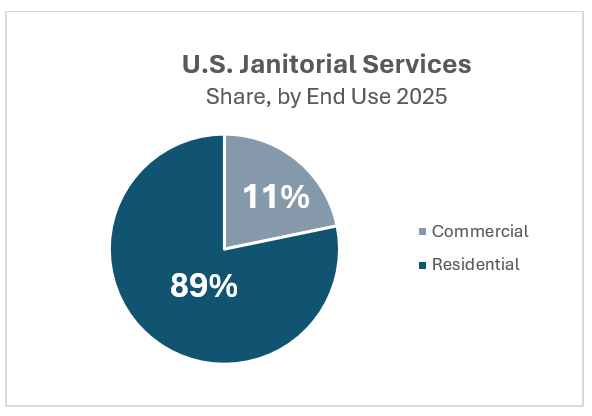
A new report from Grand View Research on the U.S. Janitorial Services Market notes that other owner considerations include advanced technology to mitigate risk of infectious disease transmission (reflecting a post-pandemic world) and for green cleaning practices and products. Yet basic standard cleaning still accounts for the largest share of the market (63%), with commercial buildings accounting for 89.3% of U.S. janitorial services in 2025.
What Flexibility Does Your Building Support Require?
Some owners want their janitorial team to assume responsibility for all aspects of the service, including choosing and ordering cleaning supplies. Others may prefer to order and maintain their own stockpiles. “Ideally, your service providers should be flexible enough to accommodate differing preferences among landlords,” advises Nick Morrissey, vice president and general manager at GNP Realty Morrissey. “GNP is large enough to have cost-saving contracts with cleaning equipment and materials suppliers but small enough to efficiently manage individual accounts to deter waste on behalf of our clients.”
Morrissey cites a large downtown museum that contracts with GNP for janitorial services. “They invest trust in us to manage the ordering and inventory levels so that their building is up to an exceptional standard,” says Morrissey. “It’s our priority to make sure we are fully stocked on necessary supplies, while minimizing any waste or inefficiencies.”
Looking for a property manager who can also provide coordinated janitorial support for seamless service?
For Hybrid Workplaces, What Adaptability Does the Space Require?
With hybrid work now the norm, building owners have reduced daily cleaning needs. “Owners are looking for places to reduce expenses, and janitorial services are a common target,” says Morrissey, adding that a 40-hour-per-week cleaning assignment is increasingly rare in Chicago due to current high office vacancy rates.
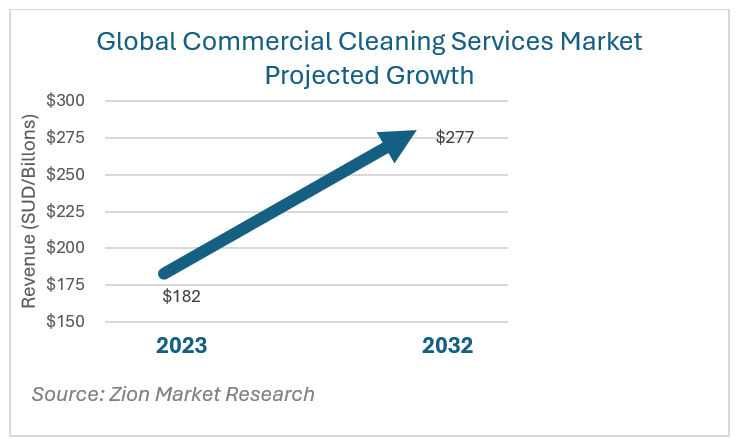
Despite changes in cleaning frequency, the commercial and residential janitorial industry remains big business in the U.S., with revenue expected to reach $112 billion this year. Over the past five years, revenue has grown by 2.7% annually. By the end of 2032, one analyst forecasts the global sector will reach $277 billion.
While it’s not reasonable to have a janitorial team whose schedule regularly changes with evolving tenant worker schedules (consistent scheduling is critical to maintaining a high-quality team of cleaners), owners should be able to talk to their property manager about the contract, while ensuring a consistent level of basic support (and resources for unanticipated needs). “We work to find amenable solutions that are a win-win for everyone,” says Morrissey.
What Rapport Do Your Tenants Expect From a Cleaning Team?
“Who will be my cleaners?” is typically the first question a prospective building owner or landlord asks when contracting for janitorial services, according to Morrissey. Tenants value the consistency of the same cleaning team. “Although most office cleaning occurs after hours, tenants often get to know their cleaners, creating a rapport that makes for a good experience for both parties,” says Morrissey.
Cleaners value consistency as well. Morrissey reports that most of GNP’s cleaners have five-plus years of experience, and that roughly 60% of the CMPS team have at least 20 years of cleaning experience.
How Will a Cleaning Team Fit Into Your Property Management Structure?
Compiling a cleaning team is about more than just consistency. Owners/landlords should expect a property manager to spend time on-site to assess cleaning needs and identify the right team of cleaners. “Beyond skills, we consider travel time and the need for cleaners to transport equipment and supplies,” says Morrissey. “In an emergency, ease and distance of travel are essential to our services. You don’t want someone from Evanston having to travel to the southside if there is an immediate need.”
Reflecting GNP’s “family” focus, cleaning teams often add family members and friends who understand and respect GNP’s high standards and enjoy being part of a close-knit team. Johanna Vargas joined GNP in 2019 as a cleaner and, seven years later, is now a supervisor.
“Starting as a janitor and working my way up to a supervisor of 40+ persons really showed me the importance of having a positive work ethic, great attention to detail and the support of not only those I supervise but also my peers and mentors,” says Vargas.
“We look for people who will take initiative and want to grow with the business,” says Morrissey. “When they grow in our business, it helps our business grow as well.”
The Power of Aligning Your Property Manager and Your Janitorial Contractor
While property management companies are typically separate entities and independent of janitorial or maintenance contracts, there are benefits to working with companies that are familiar with one another, or, in the case of GNP Realty and Chicago Management Personnel Services (CMPS), work in the same office.
Morrissey cites an example of a client who experienced a leaking valve, resulting in a significant water spill. “Our maintenance team quickly addressed the equipment failure, but because we also provide janitorial services, it was a simple process to arrange for our CMPS janitorial team to extract water from carpeting and perform other clean-up to avoid property damage and ensure tenant safety,” says Morrissey.
“The ability to coordinate between our various property management groups is especially valuable in emergencies where the time required to engage with a third party can be detrimental to the property,” adds Morrissey. A South Loop building owner who uses both GNP and CMPS services attests to the ease of having a single point of contact.
“Working with GNP and CMPS to manage and maintain the property is efficient and streamlined because I only have to make one call to get something accomplished, instead of going through multiple people or departments.”
Keith G. | GNP Client
GNP leverages its family of companies to provide cost-effective one-stop shopping for property management services. However, it recommends maintaining separate contracts for each service to ensure transparency in service delivery and billing.