

Fiduciary concerns are often the #1 reason HOA boards seek out a new management company. Discussion points to ensure a property management firm is a good fit for your HOA.
An HOA’s decision to change property management companies typically stems from a problem—something isn’t working as it should, or perhaps there is a major project on the horizon, and the board lacks confidence in the current management company. Regardless, moving from one property management firm to another is not simply an administrative change. The transition process is a significant operational event that can materially affect the resident experience, the building’s financial stability and its reputation (thereby impacting individual owners’ property values).
This is the first of a five-part series on best practices for HOAs considering a change in property management companies based on the situation driving the decision. In this first part, we focus on HOA finances (accounting and budgeting) as the driver of an HOA board’s decision to seek out a new property management company.
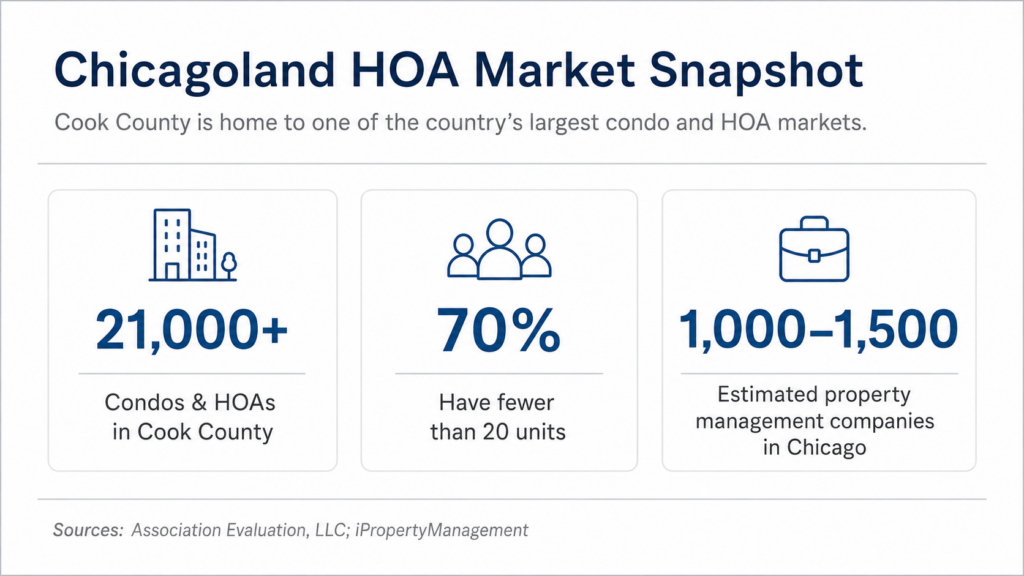
The Chicagoland condo market is among the largest in the country. According to the Chicago-based Association Evaluation, LLC, Cook County alone (including Chicago) has more than 21,000 condos and HOAs, 70% of which have fewer than 20 units. iProperty Management estimates there are between 1,000 and 1,500 unique property management companies in Chicago. Nationally, this number has spiked in recent years, suggesting a growing need for skilled property management companies.
Financial management red flags
Because the HOA board has a fiduciary responsibility to protect association assets, poor financial transparency or recurring problems with accounting, budgeting, financial reporting and internal controls can quickly erode confidence in management. Problems associated with finances prompting a change in property management companies might include;
- Late or inaccurate financial statements making it difficult for the board to make informed decisions
- Budget variances without explanation or recommended corrective actions
- Weak reserve planning that results in deficits or the need for delayed improvements or special assessments
- Poor assessment collection practices or billing errors resulting in high delinquency rates, placing greater financial pressure on owners who pay on time
- Repeated audit red flags in an independent audit
Any of these issues should concern HOA board leaders and prompt discussions about making a management change. Use the following information to guide your conversation with local property management firms.
Understand how accounting and financial processes may change
Accounting and financial management of your homeowner association is a top priority for most HOA boards. Expect a new property management company to focus solely on future financials (Day 1 of management onward). Working cooperatively with the prior manager, the newly hired firm will establish new bank accounts (operating and reserve). Once all checks have cleared and there is no further activity on the old accounts, the former management firm will send a check to the new manager for all remaining funds, and the old accounts will be closed. Expect that process to take approximately two months.
HOA board members are not permitted to be signatories on the accounts. This is an industry best practice to ensure the security of funds (and is generally required by insurance policies). If your HOA wants access to an account for miscellaneous expenditures, a good property management company will research favorable rates and assist you in setting up a separate money market or CD for HOA access.
When interviewing property management companies, discuss these points:
- Whether the HOA will have a designated property accountant
- Reporting protocols to the HOA board
- Ability for the on- or off-site property manager to make timely purchases for the building
- Review and approval process for purchases and bill pay
- What will happen to the financial records at the end of the management contract
Watch for upcoming posts focusing on HOA concerns centered on vendor management, general management response times, property portals for owners and communications.
Considering changing property managers? At GNP Realty, our experienced team is well-prepared to manage the big transition tasks (accounting, vendors, staffing and owner communications), and we also know the importance of managing the small details!
Ready to start the conversation? Contact us!